

How To Backup My Computer Windows 8.1
Biz & It —
Using Windows 8's "hidden" backup to clone and recover your whole PC
Ability to create System Images was cached in Windows 8, but not eliminated.
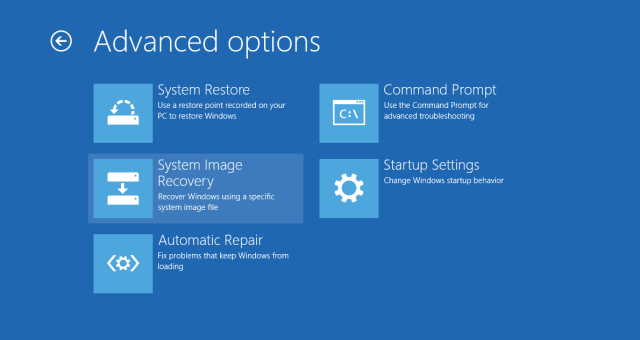
The blue screen of bringing your PC back to life.
When it comes to backing up and restoring your PC, Windows 8 took a few steps forwards and a few steps back.
Your settings and apps in the new tablet-y interface (yeah, we're still calling it Metro) are automatically backed up if you utilise a Microsoft account. That means when you restore your PC, all of the Metro stuff comes back exactly the mode you remember it. This has limitations—your desktop applications, anything that wasn't downloaded from the Windows Store, are wiped when performing the nearly easily accessible type of restore in Windows 8. Beyond Metro, all you lot become is a file on your desktop list the applications you've lost.
There'southward as well a new backup tool on the desktop side of things, but this has its limits as well. Called File History, information technology lets you automatically back up files to a network drive or cablevision-connected external hard drive every 10 minutes. As Peter Brilliant explained in an commodity terminal summer, File History'southward arrival was paired with the exit of Shadow Copies. This was a useful tool that let users revert to previous versions of files without needing to connect an external drive, and now it's gone.
One problem is neither File History nor the Metro restore feature are consummate fill-in tools. The ability to clone and restore your whole PC, files, settings, and applications—by creating a Organisation Paradigm—is gone, orseemingly gone.
Oh, at that place it is
The Organization Image functionality seems hidden at outset, and information technology will likely go unnoticed by the majority of Windows eight users. Searching the operating system for "System Image" turns upwardly nil results. Searching for "backup" or "file history" will bring you lot to the Windows 8 File History characteristic; from in that location you lot can get to the old System Image tool.
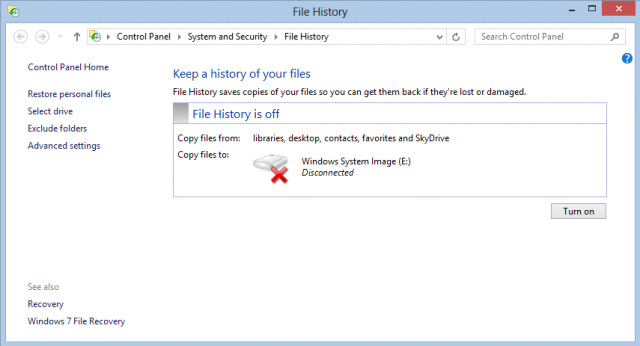
Overstate / How did I miss that?
On the bottom left y'all'll run across "Windows 7 File Recovery," and clicking that brings you to the folio for creating Arrangement Images. The name sounds similar it could refer to restoring files from a previous Windows 7 installation. But it really refers to the legacy backup tools that Windows 8 steers users abroad from but doesn't kill outright. It'south the kind of thing that seems obvious once someone has pointed information technology out to you, but Windows 8 makes no endeavor to direct users to the functionality.
Calling it "Windows 7 File Recovery" also suggests Organization Images don't have much of a future in the Windows globe. They're in Windows 8 if you tin can find them, but whether they'll stay in Windows ix or 10 is anyone's guess.
Nonetheless, it works just like information technology did in Windows seven.
You starting time from here:
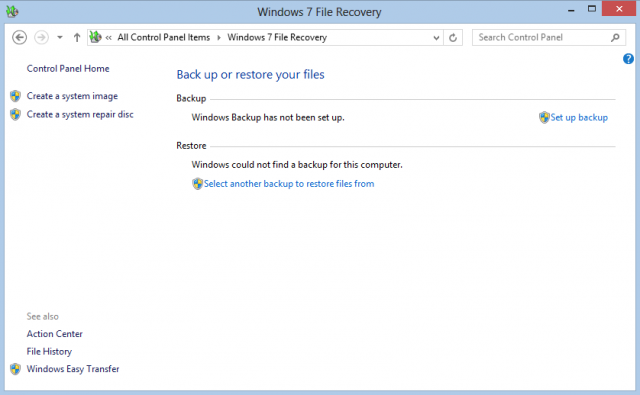
Choosing "Create a system image" on the top left lets you to clone your entire computer to a USB-connected hard drive, DVDs, or a networked drive.
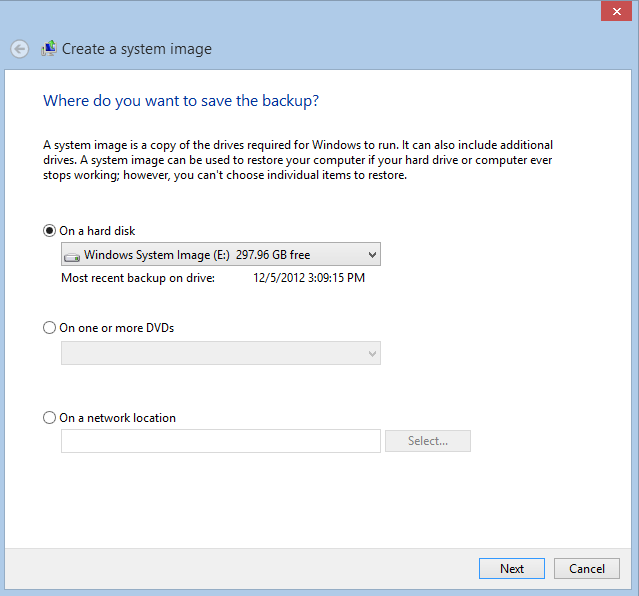
As you see higher up, Windows notifies y'all at this point that restoring from this Organization Epitome is an all-or-nothing proposition—there is no restoring private files.
But if on the previous screen yous had instead clicked "Prepare up backup," you lot'll find the selection to both create a System Epitome and create regularly occurring backups of "data files saved in libraries, on the desktop, and in default Windows folders," much as you can in the new Windows eight File History. This hedges your bets a footling—you can take a clone of your PC to restore the whole matter in example of failure, and backups of individual files if you lot're, say, wanting to restore a document you've accidentally deleted.
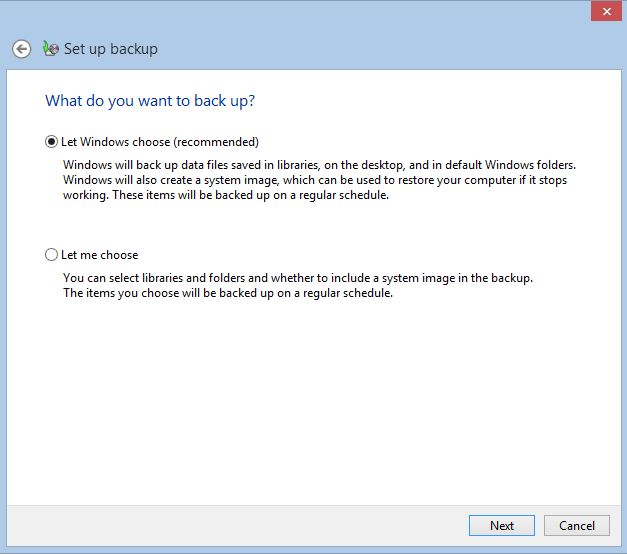
An piece of cake setup screen.
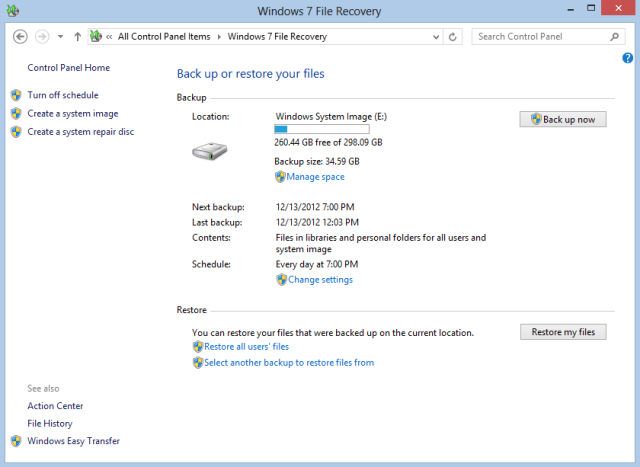
Enlarge / Regularly scheduled system imagesandfile backup can only be done through Windows vii File Recovery.
One disadvantage hither is the file backup tin only exist set up to run once every 24 hours at most, whereas the Windows 8 File History can relieve in one case an hour or even every 10 minutes. File History as well lets you specify how long to keep saved versions (e.chiliad. 1 month, one year, forever), and to proceed an offline cache. Merely the ability to accept both a arrangement epitome and file backups may be worth the sacrifice. Another alternative is to merely use both backup tools, but your mileage may vary—it's worked for me simply one reader reports that Windows viii is preventing apply of both simultaneously.
If you become the System Prototype road, it literally covers everything. When restoring your PC from a Organization Prototype, yous don't fifty-fifty need to re-type your Windows license cardinal. You tin enter the restore screen from Metro by going to PC Settings/General/Advanced Startup:
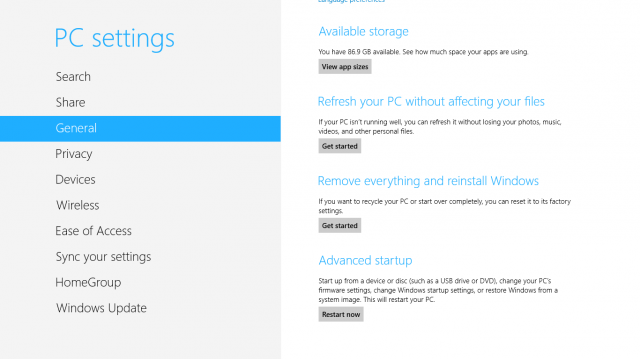
Enlarge / Click "Restart At present" under Advanced Startup.
Once in Advanced Startup Options, choose Troubleshoot/Advanced Options/Organisation Image Recovery. In that location are likewise various other means to repair your figurer here. The new-to-Windows eight "Refresh your PC" keeps your files, personal settings, and Metro apps, but deletes all your desktop applications.
If your PC is in such bad shape that you lot can't get to PC Settings, yous should automatically kick into Advanced Startup Options after a couple of restarts. Holding down ane of the Shift keys during a restart also brings up Advanced Startup Options. If the easy methods don't work, you lot might have to kicking from Windows 8 install media or a arrangement repair disc.
If you want to stick with File History but back upwardly all of your desktop applications and settings, you lot could technically do so by taking advantage of the fact that it automatically backs up everything in your libraries. To do this, yous would get into File Explorer where the music, documents, pictures, and video libraries are, create a new library, and just put your whole deejay in information technology.
In that location's another workaround if you want to use File History without an external drive, which is useful for anyone with a laptop. To do that, create a folder in Explorer (e.g. "History"), right-click it and so share it as if information technology were a network bulldoze. Then in File History, click "Add network location," and select the shared folder. In other words, you trick File History into thinking it'south backing upwards files to a different device instead of to the local disk, which is what it'southward really doing. (Don't use this method to create a System Image—restoring a PC from a Organisation Paradigm must exist done from an external source.)
The fact that these sorts of workarounds virtually seem like proficient ideas illustrates the primal problem with Windows 8 backup: there are basically three separate fill-in systems, none of which provide everything you demand.
Bitty backup
Microsoft's approach to backup in Windows 8 is a missed opportunity. Early in the development of Windows 8 it became articulate Microsoft was planning a more user-friendly backup system, for the very skillful reason that few people really back up their computers. I logical approach would have been to build upon the Organisation Image functionality to come up with something very much like Apple'southward Time Machine—in other words, automatic, hourly backups of the entire arrangement that tin can exist used to restore either individual files or the whole damn computer.
In fact, that'due south what I assumed Microsoft was working on when I first heard virtually its plans to brand backup more user-friendly in Windows. A unified backup and restore organization that can handle all backup scenarios, from individual files to the whole computer, seems like something the world'south near widely used desktop operating arrangement should take in 2012. Instead, Windows 8 provides several backup tools for different purposes. There's Metro backup, file backup, and traditional "Windows 7" System Images.
At the very least, most of the backup functionality Windows already had (minus those shadow copies nosotros mentioned) is still there in Windows viii. And the use of cloud-connected Windows accounts to back up Metro settings and apps, and preserve 1'southward Metro experience across dissimilar PCs is a user-friendly step in the right direction.
But overall, backup in Windows viii seems like a jumble of disconnected functionalities, resulting in the whole thing beingness less than the sum of its parts.
Listing paradigm by Eric.
Listing image past Eric
Source: https://arstechnica.com/information-technology/2012/12/using-windows-8s-hidden-backup-to-clone-and-recover-your-whole-pc/
Posted by: wilkinablempoore.blogspot.com
0 Response to "How To Backup My Computer Windows 8.1"
Post a Comment